
Montague Projected Versus Actual Release
TDCJ uses “Projected Release Date” for a forward-looking estimate based on the record then available. After it receives a release certificate, audits the file, and computes the event, it may post a “Scheduled Release Date” and “Scheduled Release Location.” TDCJ warns that the scheduled information may change without notice, even on the date shown.
Actual release is the completed custody event. It should be confirmed by the custodian's record, not inferred because a date passed or a name left a roster. A transfer from the Montague County Detention Center to TDCJ is continued custody. Parole approval also is not physical release while program, plan, certificate, detainer, or scheduling work remains.
A pretrial detainee usually has no sentence-based release date. Bond, dismissal, trial, sentencing, and holds can change custody. The court docket may show authority for release, while the jail record shows when processing ended.
Find Montague Projected Release Dates
Start with custody type. The TDCJ search is for people currently incarcerated in a TDCJ facility. It is not a Montague County bond-release tool and does not retain a public discharged-offender result after release.
- Confirm full name and birth date, plus a booking, cause, SID, or TDCJ number.
- For county custody, call the Montague jail at 940-894-2871 and check the judicial portal for bond, sentence, or disposition.
- For state prison, open the TDCJ Online Inmate Search. Use last name plus a first initial, or a TDCJ/SID number.
- Open the detail and read projected release, maximum sentence, parole eligibility, facility, and any scheduled date, type, and location.
- If the date passed or a result vanished, call Review and Release Processing at 512-406-5202 or request TDCJ incarceration history.
- Confirm any other-agency hold before treating the date as a community release.
The complete county search and sheriff record route is on the Montague County released inmates page. A person who bonded out without entering TDCJ may never appear in the state search.
Montague TDCJ Release Date Fields
TDCJ search results show name, TDCJ number, race, sex, projected date, unit, and age. The detail adds SID number, maximum sentence date, parole eligibility, scheduled-release information when available, and offense rows with county, cause number, and sentence.
Open the official TDCJ search before using the matched capture.
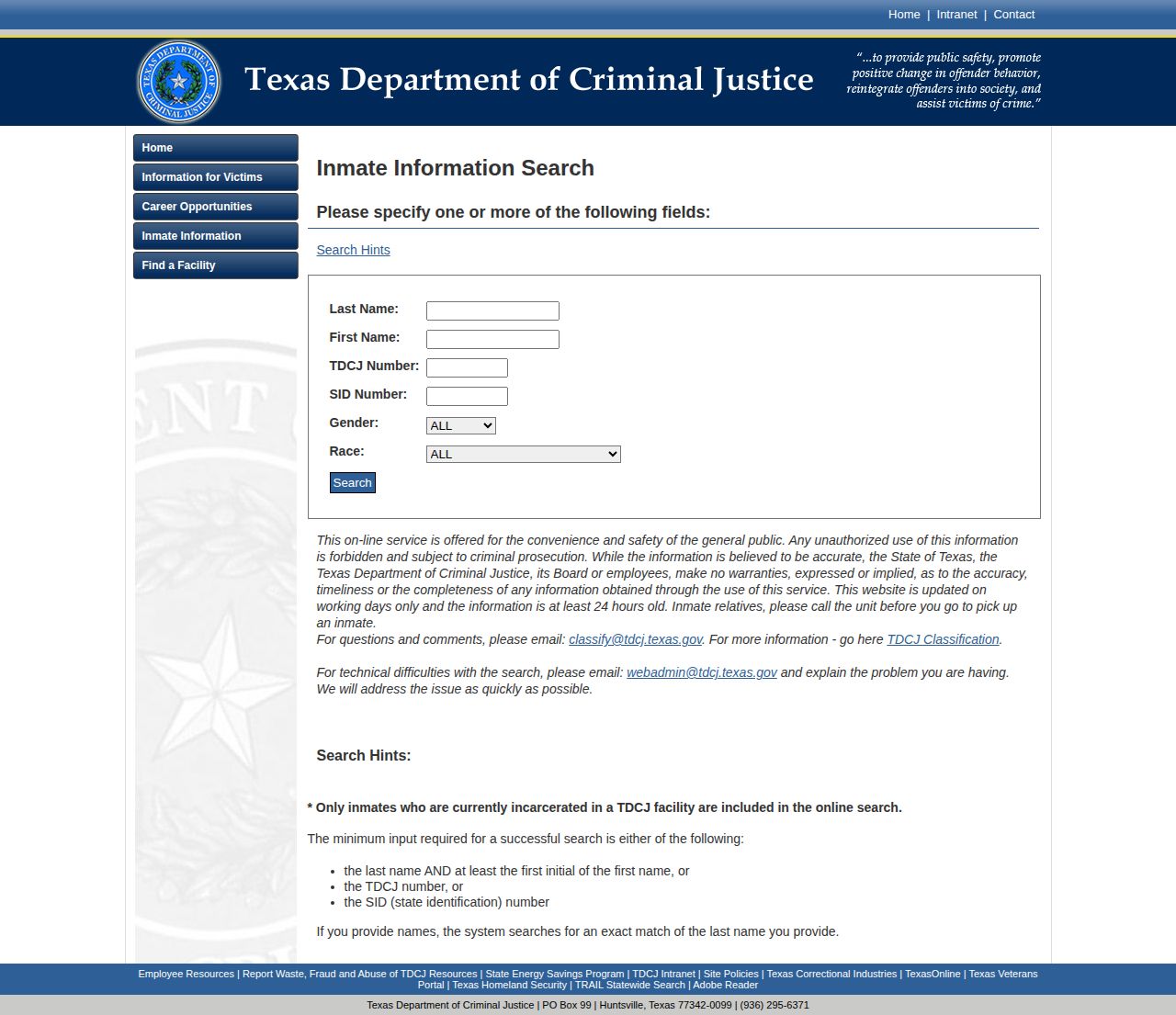
Data updates on working days and is at least 24 hours old. The display should not be described as real time.
Texas Good Time for Montague Cases
Texas Government Code §498.003 makes good-conduct time relevant to parole or mandatory-supervision eligibility. It does not directly cut the judicial sentence. Good time is a privilege, not a right. Rates depend on classification and qualifying participation; Class III earns none. Credits may be forfeited, and restoration rules matter.
A flat subtraction from every Texas sentence is wrong. Government Code §508.145 applies offense-, date-, enhancement-, and sentence-specific parole rules. Some serious offenses use actual calendar time equal to one-half of the sentence or 30 years, whichever is less, without good time. That formula is not a broad Texas “85 percent rule.” A separate federal shorthand must not be imported into a state calculation.
TDCJ Classification and Records performs the official calculation. Public records can identify inputs and the date TDCJ posts, but they cannot safely reproduce the agency's full audit through simple arithmetic.
Why Montague Release Dates Change
A projected or scheduled date can move when the legal or custodial record changes. Each factor must be checked with the office that controls it.
| Factor | Effect |
|---|---|
| Good-time classification or loss | Changes eligibility credit under TDCJ rules |
| Parole vote | May approve conditions, deny release, or set another review |
| Program or plan review | Can delay physical release after approval |
| Detainer or blue warrant | May keep custody in place or send the person elsewhere |
| New court order | May alter sentence, credit, or authority |
| File audit or certificate | Can produce or revise the scheduled date and location |
FI, NR, and SA parole codes carry specific official meanings and may include a program or review month. Do not reduce them to a loose “granted” or “denied” label. Even an FI approval can require more steps.
Montague County Jail Date Limits
The Montague County Detention Center is a county jail, not a TDCJ prison. A person awaiting trial has no calculated prison release date. A person serving a local term may have jail credit, but the research found no published local calculation policy that supports a public calculator.
Ask the sentencing clerk for the judgment and jail-time-credit entries, then ask the jail for the recorded release event. Do not promise a weekend adjustment, a set release hour, or a local good-time rate. No official source reviewed states those facts for Montague.
Note: A court order may authorize release, while jail processing determines the actual recorded time custody ends.
Confirm Montague Actual Release
For state custody, refresh the TDCJ detail and call 512-406-5202 when scheduled information changes. General location help is available at 936-295-6371 or 800-535-0283. A caller without a TDCJ or SID number should have the exact birth date.
For notifications, the Montague VINELink inmate check distinguishes participating county alerts from TDCJ IVSS. An alert is not the certified event. Note its time, then confirm with the sheriff, TDCJ, BOP, or ICE according to the actual custodian.
When two systems conflict, do not choose the newer-looking screen by instinct. Call the current custodian and request the event record. Exact language matters: listed in custody, scheduled for release, approved for parole, transferred, and recorded as released are separate findings.
TDCJ also accepts public-information email requests at pia@tdcj.texas.gov. Provide the full name and seven-digit TDCJ number, or the exact birth date, approximate age, and conviction county when the number is unknown. The official channel may supply incarceration history, current incarceration, offense, location, and projected date information without relying on a vanished public search result.
Montague Parole Eligibility Dates
Parole eligibility is the first date a case can receive consideration under the governing formula. It is not a promise of approval and not a scheduled release. The Board may deny release and set a later review. An approval may include a program, release-plan condition, or further investigation. The public detail should be quoted by field name so eligibility is not confused with the projected date.
Texas does not hold formal public individual parole hearings for ordinary parole and mandatory-release decisions. An Institutional Parole Officer prepares the case, and a three-member panel votes the file in sequence. Two matching votes decide it. The person is notified by correspondence. This process explains why there is no public hearing calendar that can predict the day of release.
A parole vote code can also affect timing. FI, NR, and SA have detailed official meanings, and suffixes can name a required program or later month. Approval still leaves release-plan review, certificates, detainer checks, and scheduling. Those remaining tasks are why the release-status line and scheduled-release block matter after a favorable vote.
Mandatory supervision follows separate statutory eligibility and exclusion rules under chapter 508. Good-conduct time may matter to eligibility, but it does not erase the sentence term. For one Montague case, the sound method is to read the TDCJ fields, obtain the official status, and avoid converting a broad statutory rule into a homemade exact date.