
Understanding Montague County Releases
The Montague County Detention Center is a county jail. It holds people awaiting court action, serving eligible local terms, awaiting transfer, or held on warrants and detainers. A person who leaves may return to the community on bond, finish a sentence, enter probation, or leave after a dismissal. The person may instead transfer to TDCJ, another county, federal custody, or immigration custody. Those outcomes all end or change the Montague booking, but only some are community releases.
A released person normally drops from the current-custody inquiry because that tool is built to show active custody. The sheriff's completed booking and release event is the strongest local record of when the person crossed the release desk and what authority was recorded. A court file can explain the bond, dismissal, judgment, sentence, or other legal basis. These records answer different parts of the same question and should be read together.
Montague County Release Types
Release language has a precise role. “Bonded” means the jail stay ended under bond while the case continues. “Time served” means credited confinement satisfied the ordered term. A dismissal ends a charge, but another cause number or hold may keep the person confined. Probation is court-ordered community supervision. Parole and mandatory supervision follow TDCJ confinement. A transfer is continued custody elsewhere.
| Recorded event | Meaning | Next source |
|---|---|---|
| Bond | County custody ends subject to bond conditions | Sheriff release event and court bond order |
| Time served or discharge | The local term or sentence obligation is completed | Release event, judgment, and jail-time credit |
| Probation | The court orders local community supervision | Montague County CSCD and the sentencing case |
| TDCJ transfer | State custody begins; it is not community release | TDCJ Online Inmate Search |
| Other-agency transfer | Custody continues with another jail, USMS, BOP, or ICE | The receiving agency and court record |
Montague County Release Record Fields
A release record is tied to one booking. Identity fields help distinguish people with similar names, while event fields describe what the jail recorded. Ask for existing fields rather than asking the Sheriff’s Office to research a theory or create a new report. The booking photograph is an associated record. It is not proof of conviction, present custody, or the outcome of the case.
| Field group | What it may show |
|---|---|
| Identity | Full name, aliases, age or birth date, and sex |
| Booking | Booking number, arresting agency, booking date and time, and charges |
| Release | Release date and time, authority or reason, bond information, and release type |
| Case | Court or cause number, sentence credit, and disposition if recorded |
| Continued custody | Receiving agency, transfer destination, or a remaining hold when public |
Verbal jail confirmation is useful for an immediate status question. A dated written response is easier to preserve and compare. For a disputed release, pair the sheriff event with the relevant court disposition. The order may explain why release was authorized, while the jail event better records when processing actually finished.
Request Montague County Release Records
The Sheriff's open-records page accepts its form online and documents email, mail, and in-person delivery paths. The form asks for contact information, the information sought, occurrence date, people involved, and a preferred delivery method. No flat local price is posted for a release record. Texas cost rules and any agency estimate control.
- Identify the person, approximate booking and release range, and booking number if known.
- Ask for the booking sheet, recorded release date and time, release authority or type, public transfer destination, remaining hold, and booking photograph as needed.
- Send the request to the Sheriff's Office, not a clerk, because the sheriff controls jail records.
- Keep the response, retrieval date, and exact status terms. Follow any transfer to its receiving agency.
111 S. Grand Street
Montague, TX 76251
Open-records contact: Audra Anderson
940-894-2491 · AAnderson@MontagueSheriff.com
The sheriff page does not promise an online retention period. Preserve the response rather than relying on a live roster. Expunction under Texas Code of Criminal Procedure chapter 55A and nondisclosure under Government Code chapter 411 are different remedies with fact-specific effects. Neither should be described as automatic removal of every independently held record.
Texas Law on Release Records
The Texas Public Information Act, Government Code chapter 552, governs access to existing sheriff records subject to applicable exceptions. It requires prompt handling, but it does not require an office to create a custom release list that it does not maintain. Juvenile information, sealed material, protected identifiers, and records covered by a valid expunction or nondisclosure order require separate analysis. The Attorney General's requestor guidance explains estimates, clarification, and the decision process.
Two Montague Release Record Routes
Montague County expressly separates executive records from judicial records. A jail release event belongs with the Sheriff's Office. A felony disposition, judgment, bond order, or case filing belongs with the clerk and judicial system. These records answer different questions and should be obtained separately.
Use the Montague judicial portal for available case searches. The District Clerk also provides a dedicated request form and warns that older cases may not be online. Its posted form allows up to ten business days and lists different charges for name research, certification, paper pages, and electronic documents. Obtain the sheriff event and court authority separately, then reconcile their dates.
The successful capture of the Montague court search shows the official landing point used for that second track.
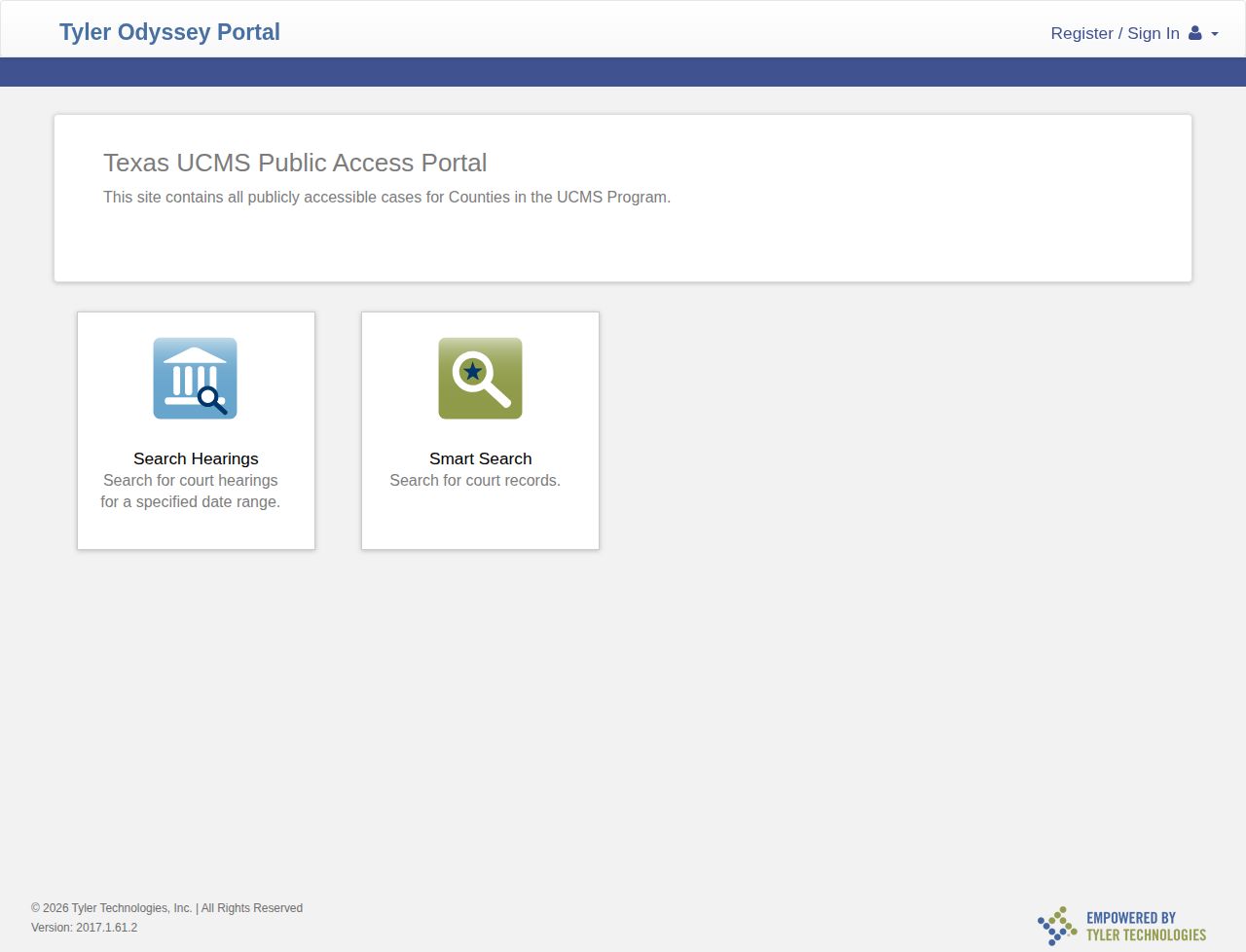
The portal can locate the case context, but the sheriff remains the custodian of the physical release event.
Route Montague Release Requests Correctly
The county open-records instructions warn that each elected official controls that department's records. A request sent to the wrong department need not be forwarded. Send jail booking, release, and photograph requests to the sheriff; court-file requests to the correct clerk; probation questions to CSCD; and prison or parole requests to TDCJ. Correct routing avoids delay and preserves the distinction between the release event and the legal case.
Find Released Montague County Inmates
Choose the custody system before searching. A recent local arrest begins with the jail. A state-prison sentence moves the search to TDCJ. Federal sentencing, federal pretrial custody, and immigration detention each have different custodians. The following sequence preserves those distinctions.
- Check the Montague current-custody inquiry and call the 24-hour jail line. If absent, ask whether the booking closed, transferred, or remains under another number or hold.
- Request the sheriff booking and release event. Use the 24-Hour Release List and 72-hour explanation for date-bounded fallback wording.
- Search the court portal by name or cause number for bond, dismissal, judgment, sentence, or transfer authority.
- If a state sentence exists, search TDCJ. Read unit, county of conviction, projected date, eligibility, and scheduled-release fields together.
- Use parole, probation, IVSS, BOP, USMS, or ICE only when the custody path supports that system.
TDCJ Search After Montague Transfer
The TDCJ Online Inmate Search covers people currently incarcerated in a TDCJ facility. It is not a county bond-release search and not a public archive of discharged people. A person transferred from Montague may be housed anywhere in Texas. Once released, the public entry drops out, so absence still does not prove the date or type of departure.
| Search input | Use |
|---|---|
| Last name plus first initial | Minimum name route |
| TDCJ or SID number | Stronger unique match |
| First name, sex, race | Optional narrowing fields |
| Exact birth date | Needed for phone help when no ID number is known |
Results and details can show unit assignment, offense and conviction county, projected release date, parole eligibility, maximum sentence date, and a scheduled date, type, or location block. A projection is not a completed release. TDCJ says working-day data is at least 24 hours old and scheduled dates can change without notice.
The official TDCJ search screen states the current-only scope and displays its input fields.
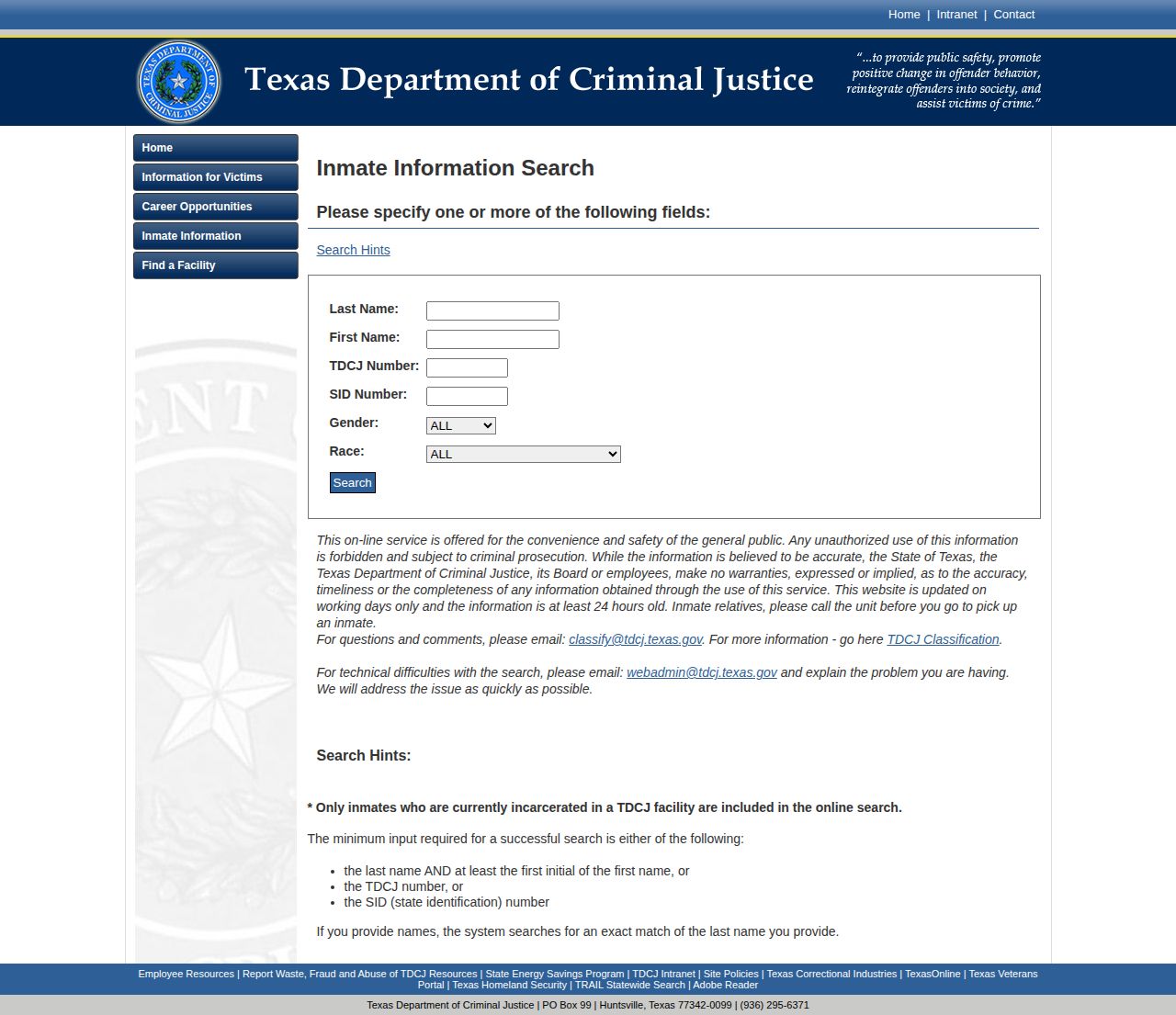
After an entry disappears, use TDCJ telephone, email, incarceration-history, and parole channels rather than turning the missing result into a release claim.
Montague County Has No Release Feed
No official rolling 24-hour or 72-hour release feed was found. The sheriff-linked inquiry is current-only. Its fields and sampled detail describe active booking data, not a release event. Archived 2019 and 2020 custody pages can narrow the period in which a name disappeared, but they cannot distinguish bond, transfer, sentence completion, another hold, or a data change. Pair adjacent snapshots with a call and written sheriff request.
Montague Supervision After Release
Probation is imposed by a court and administered locally by Montague County Community Supervision and Corrections Department. Parole and mandatory supervision follow TDCJ confinement and are administered by the TDCJ Parole Division; Montague County maps to the Wichita Falls District Parole Office. The court order controls probation status. TDCJ and parole channels control state supervision. The Parole & Probation page gives both office routes and explains Texas file review.
- Probation
- Court-ordered community supervision, including some deferred-adjudication cases.
- Parole
- Conditional release after part of a TDCJ sentence, with supervision continuing.
- Discharge
- Legal completion of the sentence obligation, which is different from release onto supervision.
- Detainer
- Another authority's hold that can prevent community release after one case clears.
Montague Alerts and Federal Releases
Notifications are prospective alerts, not release certificates. Texas uses IVSS for TDCJ custody, parole, and mandatory-supervision changes. County VINE participation must be confirmed in the live service. Search the correct agency and person, register for an offered event, and check any “released” or “transferred” alert with the custodian.
The BOP locator applies to federally sentenced people and can show historical releases. The U.S. Marshals Service handles many federal pretrial detainees, who may be housed under contract and absent from BOP. ICE ODLS applies only when immigration custody is plausible. A person leaving Montague for any of these custodians was transferred, not released to the community.
The successful BOP locator capture illustrates the separate federal search route.
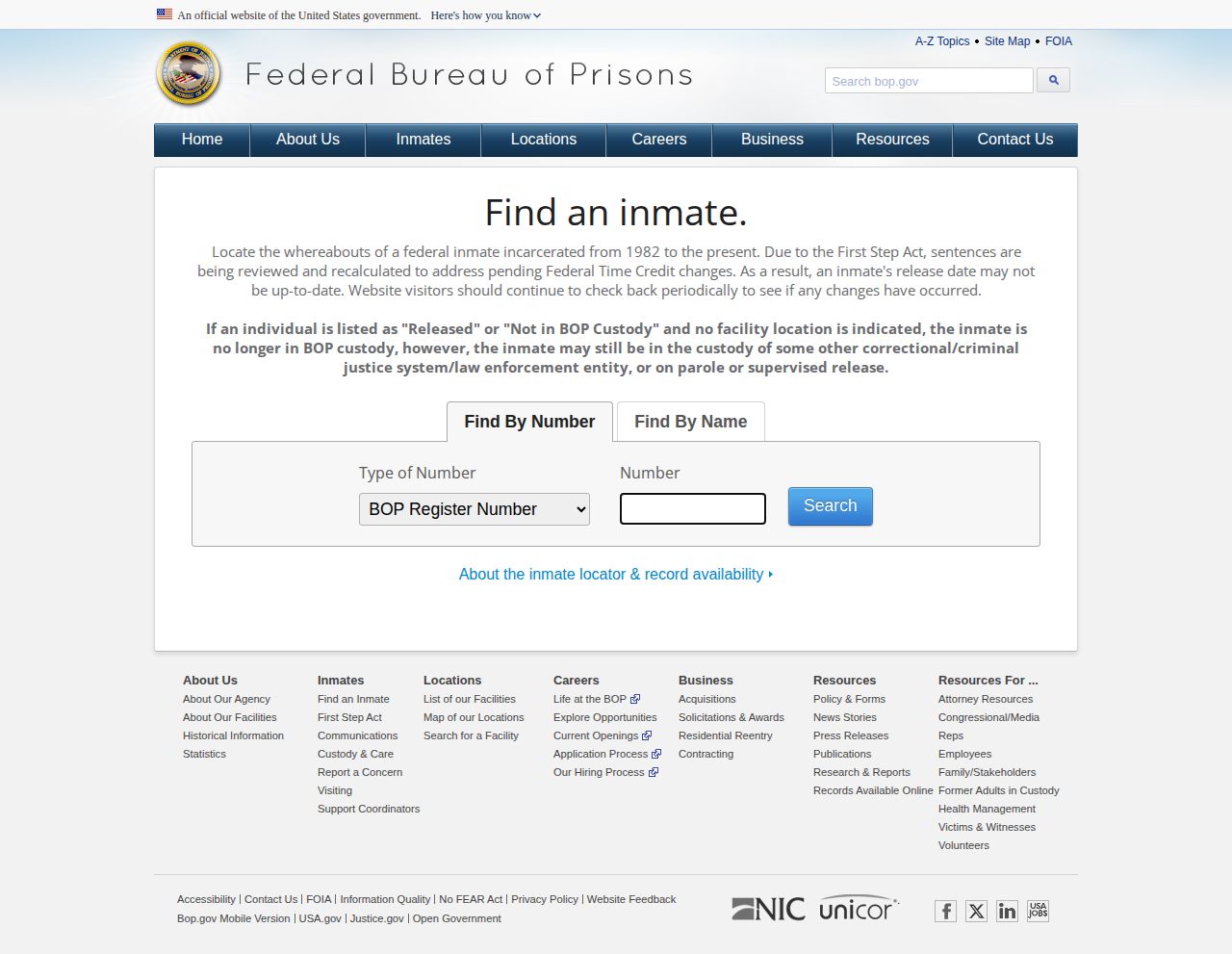
A BOP release result does not rule out local, state, immigration, or post-release supervision status.
Where Montague Release Records Appear
Each source proves a limited fact. Use the smallest set that matches the known path, then preserve the exact wording and search date.
| Source | Best use | Critical limit |
|---|---|---|
| County custody inquiry | Current Montague jail custody | Absence is not proof of release |
| Sheriff release event | Completed county booking outcome | Must be requested when not posted |
| Montague court portal | Bond, dismissal, judgment, sentence | May not show physical release time |
| TDCJ search | Current state-prison location and future dates | Current-only, not a discharge archive |
| BOP locator | Federal sentenced custody and releases | Does not cover every federal detainee |
Montague County Detention Facility
The Montague County Detention Center is the only county correctional facility identified in the official directories reviewed. It is a 101-bed, indirect-supervision jail operated by the Sheriff's Office. No TDCJ prison, BOP institution, or ICE detention center was identified inside the county. Municipal arrests commonly route to county custody, but the actual booking agency and destination should always be confirmed.
Confirm Montague Bond Releases
The Sheriff's Office maintains an approved bail-bond companies page, but arranging or paying a bond is not proof that physical release is complete. Other causes, warrants, detainers, and processing steps can keep someone in custody. Confirm payment instructions directly with the jail. Local reporting records the sheriff's warning that jail staff do not solicit bond payments through Venmo, Cash App, or Zelle.
Getting Home After Montague Release
TAPS Public Transit lists Montague County in its service area and describes demand-response service. No official source promises a detention-center stop or a ride timed to a release. A person considering that option should check eligibility and schedule in advance. The jail publishes no fixed release time, public waiting area, property pickup schedule, or transportation arrangement, so families should call the 24-hour line for current instructions.
Montague Reentry Service Leads
The TDCJ Reentry Resource Guide contains a Montague County section with named Bowie and Nocona contacts, including the Helen Farabee Centers Bowie location and Nocona's Carpenter Shop transportation listing. The guide is a starting point, not a promise that a program has space or covers the person's needs. Call each provider to confirm current scope, eligibility, schedule, and service area.
Current Montague Jail Address
The operating Montague County Detention Center is the 101-bed facility at 111 South Grand Street. A separate 1927 county jail appears in local historical material and the Texas Historical Commission atlas. It is not the current booking facility. This distinction matters when an image search or old address result appears beside a modern custody question.